





The de minimis exemption may sound like a minor detail, but it's actually crucial for smaller shipments.
For e-commerce businesses, understanding how to calculate potential customs fees is essential – not
just to price shipments correctly, but also to know when you can avoid customs clearance altogether.
Sellers must provide detailed shipment descriptions, including the product’s country of origin, HS code, item value, shipping value, and both sender and recipient information.
DDP (Delivery Duty Paid): Customs duties and VAT are paid by the sender.
DDU (Delivery Duty Unpaid): Customs duties and VAT are paid by the recipient.
DAP (Delivered At Place): The sender covers duties and taxes up to delivery at the specified location, but the recipient is responsible for customs procedures and any charges at customs.
De minimis was a customs rule that allowed goods valued at up to $800 to enter the U.S. without detailed customs clearance or duties. As of August 29, 2025, this exemption is being removed, meaning that every shipment, regardless of its value, must now be declared and taxed. Even accessories, T-shirts, or toys will be subject to standard customs requirements, significantly changing shipping costs and procedures
for e-commerce businesses operating outside the U.S.
By choosing DDP, an e-commerce business takes responsibility for all customs duties and payments related to importing goods into the U.S., ensuring clarity and security for both the seller and the recipient.
1. Accurate cost control and budgeting.
You can calculate all customs and delivery costs in advance and include them in the product or shipping price. This helps avoid unexpected expenses, such as return shipping fees, which may occur if
duties are left for the recipient to pay.
2. Simplified customs procedures and reduced administrative workload.
Couriers such as FedEx, DHL, and UPS prefer DDP shipments because they reduce the complexity of customs formalities and administrative tasks.
3. Better customer experience.
DDP supports a positive shopping experience and increases customer trust in your business. This is especially important in the highly competitive e-commerce market, where customer satisfaction can be decisive for a company’s success.
Let’s look at how customs duties are calculated for U.S.–bound shipments and then how the customs process works in the Swotzy shipping platform.
Custom duties include:
🟡 Import duties
A specific type of customs duty, with the rate determined by the product category and its value.
🟡 VAT
Value-added tax, calculated based on the product value + shipping costs + customs duties + import duties. Under Latvian and EU legislation, exports (sales to non-EU countries) fall under the zero-rated VAT regime, meaning the exporter does not charge VAT but retains the right to recover VAT paid on previous expenses.
🟡 MPF (Merchandise Processing Fee)
A mandatory U.S. fee for processing customs documentation, charged regardless of the courier. For shipments up to $2,500, the fixed rate is €2.41.
🟡 Courier surcharges
Additional processing and service fees from FedEx, UPS, DHL, etc., covering the preparation of customs documents and related formalities.
Each shipment is assessed individually. Different types of goods may be subject to higher or lower duty
rates depending on their category.
These rates are calculated based on the HS code (Harmonized System code), the international classification code assigned to each product. Once the correct HS code is applied, the customs system automatically determines the applicable duty rate, import charges, and VAT amount.
💡If the HS code is assigned incorrectly (for example, “cotton T-shirt” vs. “synthetic sports jacket”),
the costs can differ by tens of percent.
In addition to these components, sellers must also consider courier-specific price changes.
Due to the removal of the de minimis threshold, FedEx, UPS, and DHL have introduced new courier processing and service fees for shipments from Latvia to the U.S.
FedEx
DHL
UPS
The customs cost depend on what you're shipping. So, to calculate custom costs, you need to know what makes up the total shipping cost. Here are the variables:
📑 HS code: Product classification for customs.
💰 Declared value: The item’s price.
🚚 Shipping cost: The courier’s charge for delivery.
👮 Customs duties: Based on the item category and country of origin.
🇺🇸 VAT: Calculated from the item value and customs duties.
💵 Courier surcharge: Applied by the courier for customs processing after the removal of the de minimis threshold.
👕 MPF: U.S. Customs and Border Protection processing fee for handling shipment documents. For small items, this fee is €2.41.
You don’t need to memorize all the details to get the numbers – just use a customs calculator.
Once you know your product's HS code, total value, and the shipping cost (find out on Swotzy by creating a new shipment), you can calculate your customs.
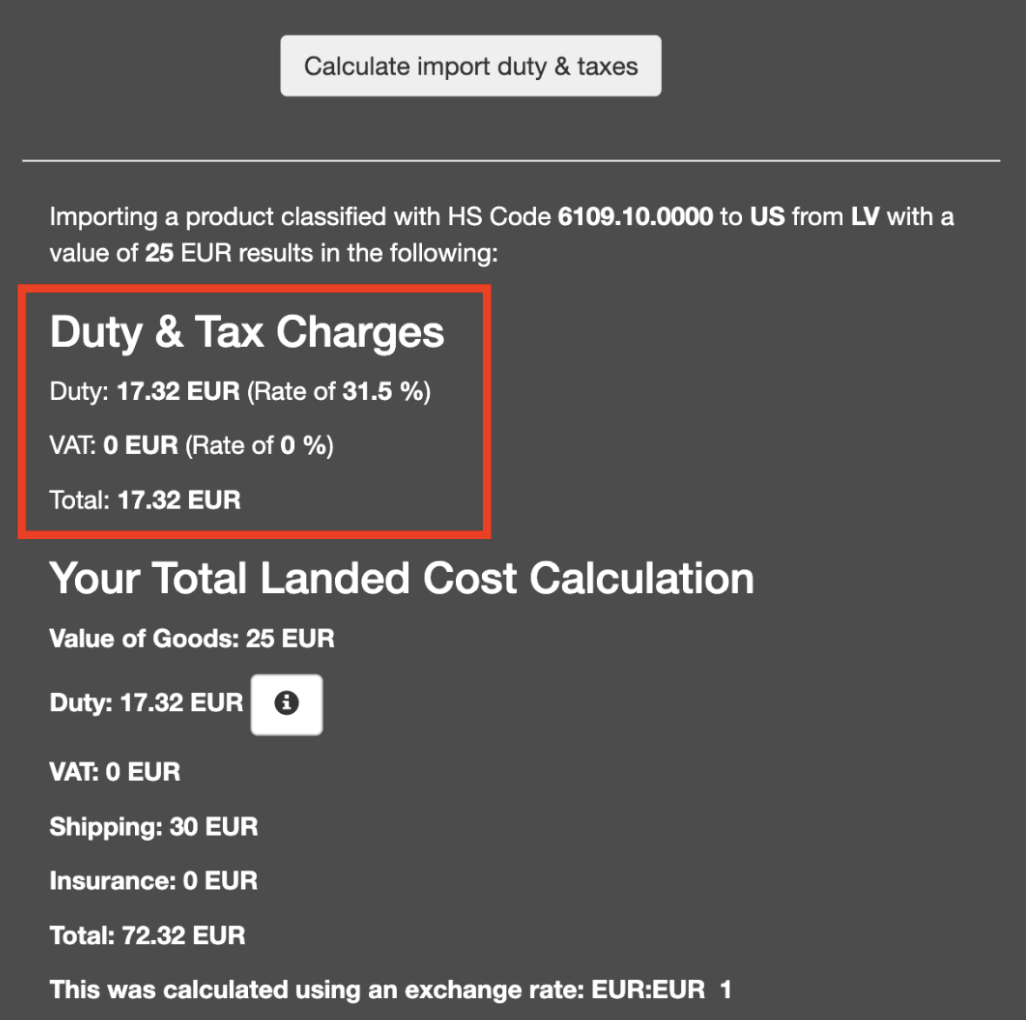
Product: Cotton T-shirt [HS code: 6109.10] 👕
Declared value: €25
Shipping cost using the chosen courier service: €30
Import duty: 31.5% of the item value → 25 × 0.315 = €7.88
VAT: €0 (0%)
Courier surcharge: €4.50 flat fee
MPF: €2.41
Total customs and additional fees: 7.88 + 0 + 4.50 + 2.41 = €14.79
Final calculation:
Item: €25
Shipping: €30
Customs + surcharges: €14.79
Total: €69.79
Keep in mind that choosing to ship with DDU carries the risk of additional or unexpected costs, such as storage fees or return charges.
The recipient will be responsible for handling customs formalities, which are often complex and not easy
for everyone to understand. This may lead to situations where customers refuse the shipment or even
return it—something that not only harms your business reputation but can also result in unnecessary expenses.
To avoid these issues and make shipping to the U.S. simple and secure, we recommend using a
professional shipping platform like Swotzy, which helps manage customs procedures and reduces
the risk of unexpected costs.
When creating shipments through the Swotzy platform, you can easily compare offers from different
couriers and choose the option that suits you best—whether it’s the most cost-effective or the fastest.
The platform automatically generates all required customs documents, sends them to the courier, and provides users with weekly reports on all shipments and their total costs, including customs fees.
This makes the entire shipping process simple, transparent, and secure.
If you don’t have a Swotzy profile yet, register [here]. In the left-hand menu, you’ll find the “Integrations” section. Select your e-commerce platform and follow the guided steps. Alternatively, you can upload shipments via the “Create Shipment” button in the top menu.
You can create and send a shipment in six easy steps:
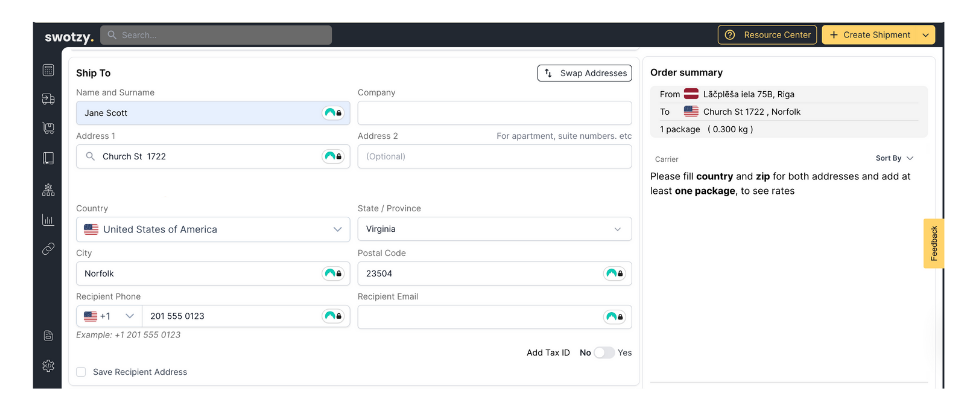
Select one of your orders and click “Create Shipment.” Make sure the chosen address from the dropdown menu is correct.
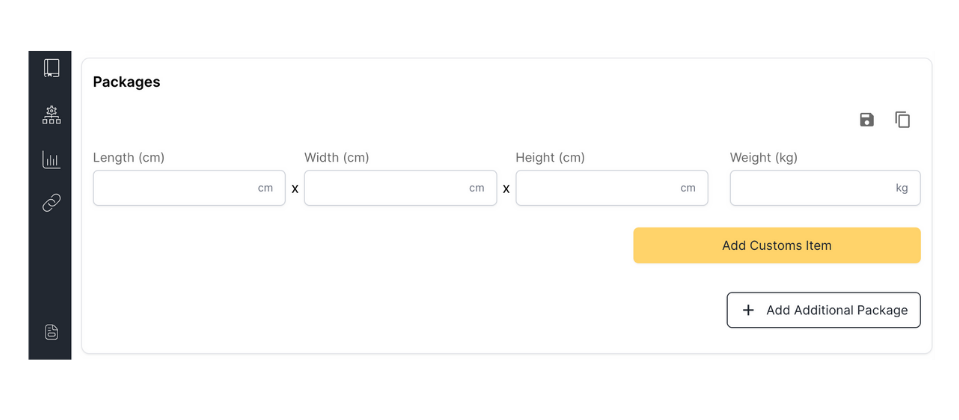
Below the address fields, in the “Packages” section, enter the package dimensions, length, width, height, and weight.
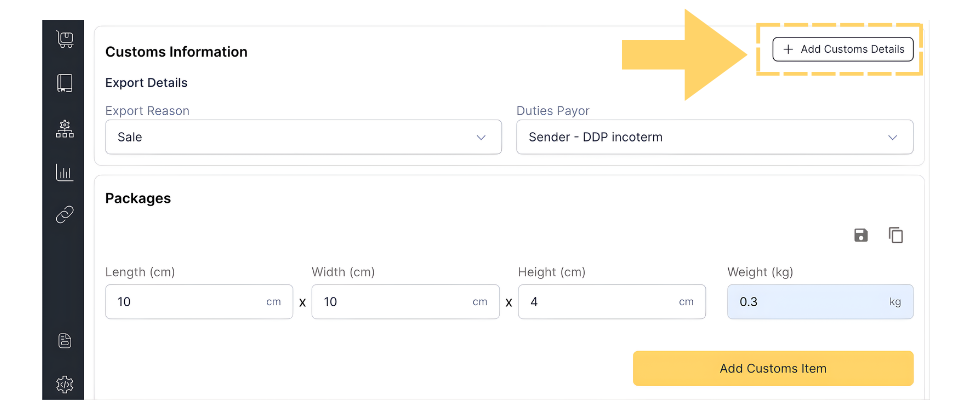
Once you enter the package details, a “Customs Information” window will appear.
Click → “+ Add Customs Details”.
Here you can choose to upload your own customs document or manually fill in the customs fields. Swotzy will generate this information as an official customs document, which will be sent to your selected courier.
💡 If you choose the second option at the top of the window: “upload your invoice,” it’s important to specify the Export Reason. In the Duties Payor section, make sure DDP Incoterm is selected.
The uploaded invoice must include complete information about the sender, recipient, product, and its value.
Let’s add the customs information manually.
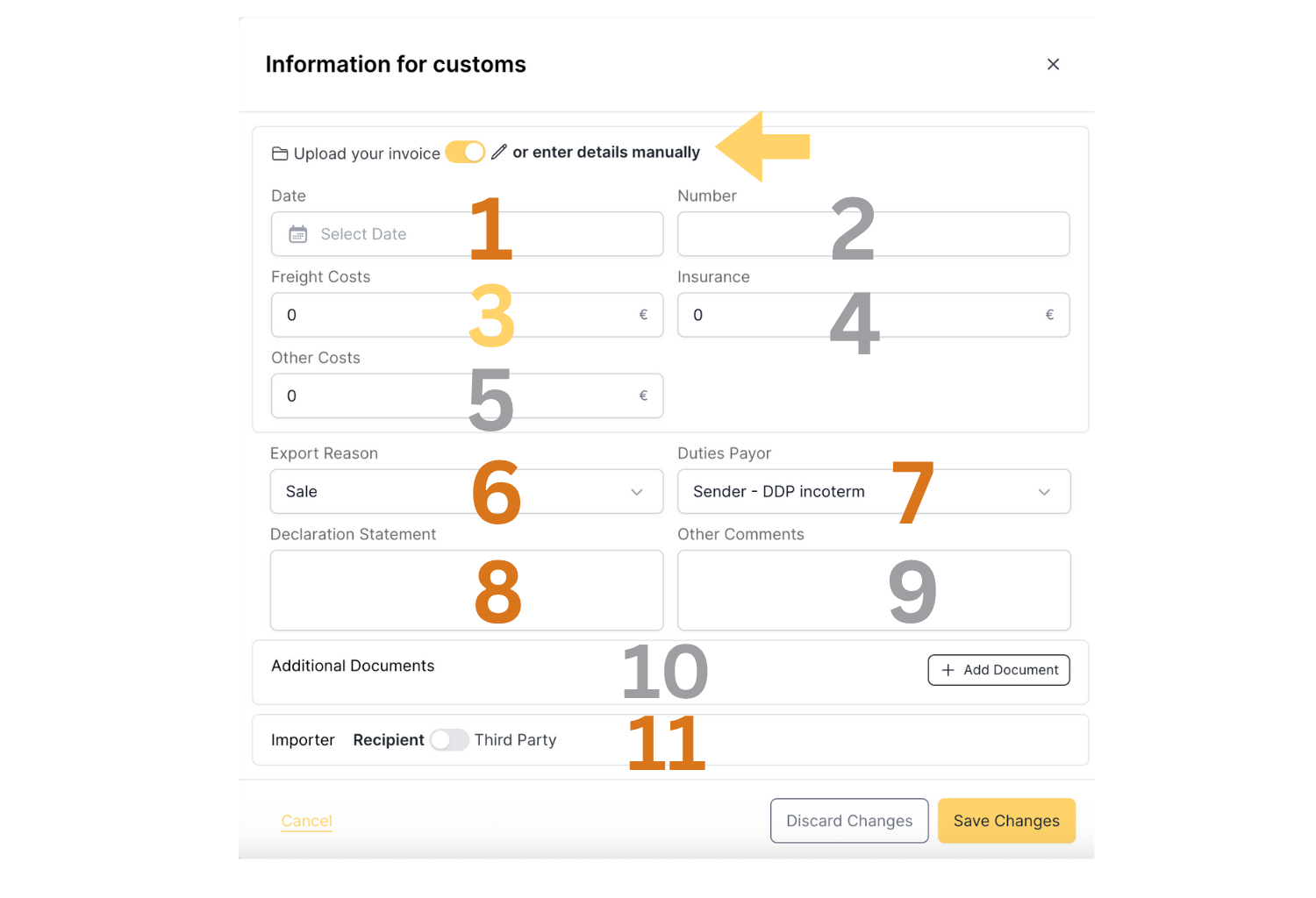
🟠 Mandatory fields are marked with orange numbers.
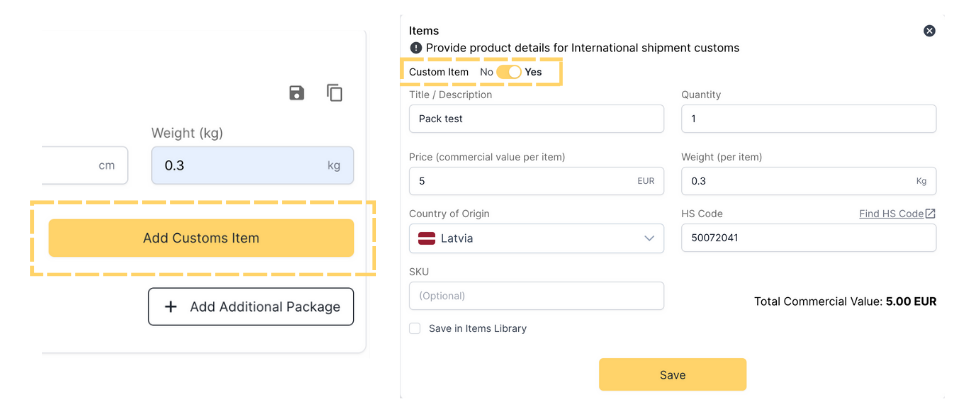
Next, click the yellow “Add Customs Item” button and fill in the required information.
All details – item description, quantity, value, HS code, and sender and recipient information – must be included so that customs authorities can calculate the applicable duties and taxes.
5. Choose a courier service
Available courier services will appear in the right-hand menu. For shipments to the U.S., you can currently choose FedEx, DHL, or UPS.
💡The courier’s applicable surcharge is already included in the displayed shipment price.
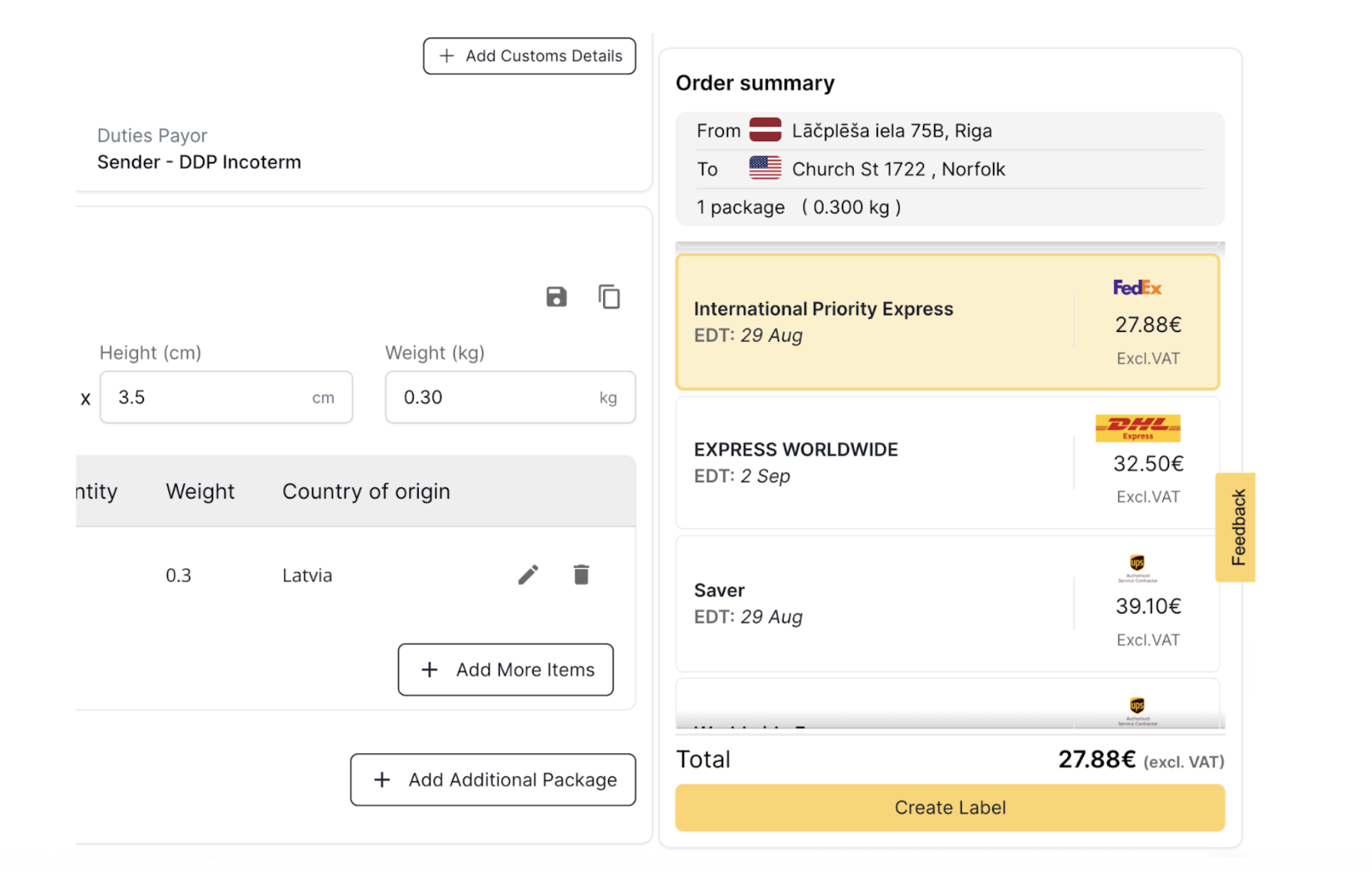
6. Create the shipment label
Click the yellow “Create Label” button to generate the label automatically. This label should be used for attaching to the shipment package.
7. Request the courier
Once the shipment label is created, you can conveniently request the courier directly through the Swotzy platform at no additional cost.
That’s it!
By the way, you can also save frequently used package, address, and item information for faster shipment creation in the future.
Based on the shipment information you provide, Swotzy will automatically generate a commercial invoice and all other required customs documents.
By choosing yourself as the customs payer (DDP), you provide your customers with a clear, fast, and pleasant delivery experience, avoiding unwanted delays and extra costs.
For a smooth customs process, it’s essential to provide accurate item descriptions, HS codes, and declared values, as these affect the calculation of customs duties.
Remember:
The Swotzy platform gives you faster logistics advantages by automatically generating commercial invoices and customs documents. All you need to do is create your shipment in a few clicks and select the most suitable courier service.
🚚✨ Happy shipping!

The de minimis exemption may sound like a minor detail, but it's actually crucial for smaller shipments.
For e-commerce businesses, understanding how to calculate potential customs fees is essential – not
just to price shipments correctly, but also to know when you can avoid customs clearance altogether.
Sellers must provide detailed shipment descriptions, including the product’s country of origin, HS code, item value, shipping value, and both sender and recipient information.
DDP (Delivery Duty Paid): Customs duties and VAT are paid by the sender.
DDU (Delivery Duty Unpaid): Customs duties and VAT are paid by the recipient.
DAP (Delivered At Place): The sender covers duties and taxes up to delivery at the specified location, but the recipient is responsible for customs procedures and any charges at customs.
De minimis was a customs rule that allowed goods valued at up to $800 to enter the U.S. without detailed customs clearance or duties. As of August 29, 2025, this exemption is being removed, meaning that every shipment, regardless of its value, must now be declared and taxed. Even accessories, T-shirts, or toys will be subject to standard customs requirements, significantly changing shipping costs and procedures
for e-commerce businesses operating outside the U.S.
By choosing DDP, an e-commerce business takes responsibility for all customs duties and payments related to importing goods into the U.S., ensuring clarity and security for both the seller and the recipient.
1. Accurate cost control and budgeting.
You can calculate all customs and delivery costs in advance and include them in the product or shipping price. This helps avoid unexpected expenses, such as return shipping fees, which may occur if
duties are left for the recipient to pay.
2. Simplified customs procedures and reduced administrative workload.
Couriers such as FedEx, DHL, and UPS prefer DDP shipments because they reduce the complexity of customs formalities and administrative tasks.
3. Better customer experience.
DDP supports a positive shopping experience and increases customer trust in your business. This is especially important in the highly competitive e-commerce market, where customer satisfaction can be decisive for a company’s success.
Let’s look at how customs duties are calculated for U.S.–bound shipments and then how the customs process works in the Swotzy shipping platform.
Custom duties include:
🟡 Import duties
A specific type of customs duty, with the rate determined by the product category and its value.
🟡 VAT
Value-added tax, calculated based on the product value + shipping costs + customs duties + import duties. Under Latvian and EU legislation, exports (sales to non-EU countries) fall under the zero-rated VAT regime, meaning the exporter does not charge VAT but retains the right to recover VAT paid on previous expenses.
🟡 MPF (Merchandise Processing Fee)
A mandatory U.S. fee for processing customs documentation, charged regardless of the courier. For shipments up to $2,500, the fixed rate is €2.41.
🟡 Courier surcharges
Additional processing and service fees from FedEx, UPS, DHL, etc., covering the preparation of customs documents and related formalities.
Each shipment is assessed individually. Different types of goods may be subject to higher or lower duty
rates depending on their category.
These rates are calculated based on the HS code (Harmonized System code), the international classification code assigned to each product. Once the correct HS code is applied, the customs system automatically determines the applicable duty rate, import charges, and VAT amount.
💡If the HS code is assigned incorrectly (for example, “cotton T-shirt” vs. “synthetic sports jacket”),
the costs can differ by tens of percent.
In addition to these components, sellers must also consider courier-specific price changes.
Due to the removal of the de minimis threshold, FedEx, UPS, and DHL have introduced new courier processing and service fees for shipments from Latvia to the U.S.
FedEx
DHL
UPS
The customs cost depend on what you're shipping. So, to calculate custom costs, you need to know what makes up the total shipping cost. Here are the variables:
📑 HS code: Product classification for customs.
💰 Declared value: The item’s price.
🚚 Shipping cost: The courier’s charge for delivery.
👮 Customs duties: Based on the item category and country of origin.
🇺🇸 VAT: Calculated from the item value and customs duties.
💵 Courier surcharge: Applied by the courier for customs processing after the removal of the de minimis threshold.
👕 MPF: U.S. Customs and Border Protection processing fee for handling shipment documents. For small items, this fee is €2.41.
You don’t need to memorize all the details to get the numbers – just use a customs calculator.
Once you know your product's HS code, total value, and the shipping cost (find out on Swotzy by creating a new shipment), you can calculate your customs.
Product: Cotton T-shirt [HS code: 6109.10] 👕
Declared value: €25
Shipping cost using the chosen courier service: €30
Import duty: 31.5% of the item value → 25 × 0.315 = €7.88
VAT: €0 (0%)
Courier surcharge: €4.50 flat fee
MPF: €2.41
Total customs and additional fees: 7.88 + 0 + 4.50 + 2.41 = €14.79
Final calculation:
Item: €25
Shipping: €30
Customs + surcharges: €14.79
Total: €69.79
Keep in mind that choosing to ship with DDU carries the risk of additional or unexpected costs, such as storage fees or return charges.
The recipient will be responsible for handling customs formalities, which are often complex and not easy
for everyone to understand. This may lead to situations where customers refuse the shipment or even
return it—something that not only harms your business reputation but can also result in unnecessary expenses.
To avoid these issues and make shipping to the U.S. simple and secure, we recommend using a
professional shipping platform like Swotzy, which helps manage customs procedures and reduces
the risk of unexpected costs.
When creating shipments through the Swotzy platform, you can easily compare offers from different
couriers and choose the option that suits you best—whether it’s the most cost-effective or the fastest.
The platform automatically generates all required customs documents, sends them to the courier, and provides users with weekly reports on all shipments and their total costs, including customs fees.
This makes the entire shipping process simple, transparent, and secure.
If you don’t have a Swotzy profile yet, register [here]. In the left-hand menu, you’ll find the “Integrations” section. Select your e-commerce platform and follow the guided steps. Alternatively, you can upload shipments via the “Create Shipment” button in the top menu.
You can create and send a shipment in six easy steps:
Select one of your orders and click “Create Shipment.” Make sure the chosen address from the dropdown menu is correct.
Below the address fields, in the “Packages” section, enter the package dimensions, length, width, height, and weight.
Once you enter the package details, a “Customs Information” window will appear.
Click → “+ Add Customs Details”.
Here you can choose to upload your own customs document or manually fill in the customs fields. Swotzy will generate this information as an official customs document, which will be sent to your selected courier.
💡 If you choose the second option at the top of the window: “upload your invoice,” it’s important to specify the Export Reason. In the Duties Payor section, make sure DDP Incoterm is selected.
The uploaded invoice must include complete information about the sender, recipient, product, and its value.
Let’s add the customs information manually.
🟠 Mandatory fields are marked with orange numbers.
Next, click the yellow “Add Customs Item” button and fill in the required information.
All details – item description, quantity, value, HS code, and sender and recipient information – must be included so that customs authorities can calculate the applicable duties and taxes.
5. Choose a courier service
Available courier services will appear in the right-hand menu. For shipments to the U.S., you can currently choose FedEx, DHL, or UPS.
💡The courier’s applicable surcharge is already included in the displayed shipment price.
6. Create the shipment label
Click the yellow “Create Label” button to generate the label automatically. This label should be used for attaching to the shipment package.
7. Request the courier
Once the shipment label is created, you can conveniently request the courier directly through the Swotzy platform at no additional cost.
That’s it!
By the way, you can also save frequently used package, address, and item information for faster shipment creation in the future.
Based on the shipment information you provide, Swotzy will automatically generate a commercial invoice and all other required customs documents.
By choosing yourself as the customs payer (DDP), you provide your customers with a clear, fast, and pleasant delivery experience, avoiding unwanted delays and extra costs.
For a smooth customs process, it’s essential to provide accurate item descriptions, HS codes, and declared values, as these affect the calculation of customs duties.
Remember:
The Swotzy platform gives you faster logistics advantages by automatically generating commercial invoices and customs documents. All you need to do is create your shipment in a few clicks and select the most suitable courier service.
🚚✨ Happy shipping!
Free to join. Free to use. Only pay for shipped orders.
Whether you’re just starting out or scaling fast, Swotzy helps you save on shipping, manage all your deliveries better, and keep your shipping process simple and efficient.